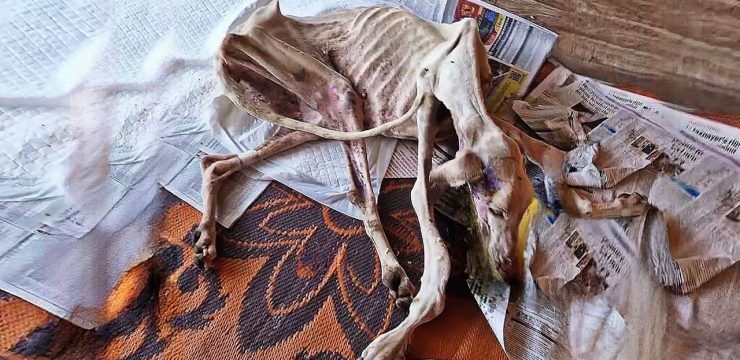
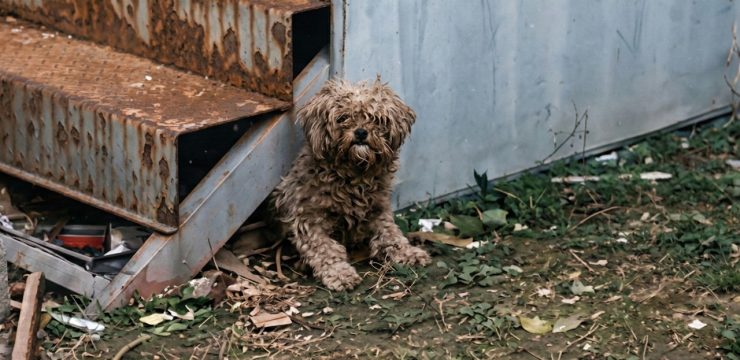
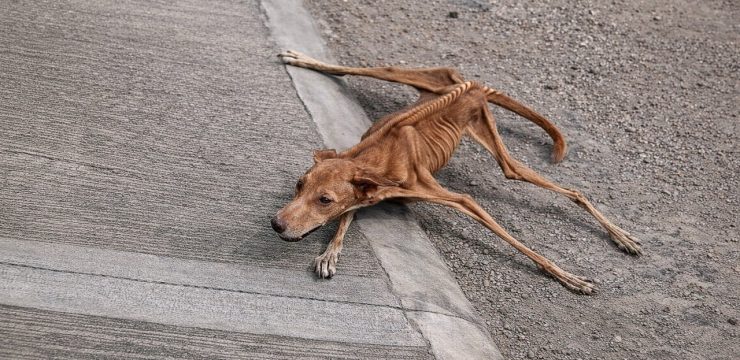
Dymok was only two years old when he was found lying beside a trash can, unable to move. For three long weeks, he had survived on scraps tossed away by strangers, dragging himself as best he could, waiting in silent agony for someone to notice him. His small body was frail, his eyes dull with exhaustion, yet there was still something there—a quiet plea, a fragile spark that refused to go out.
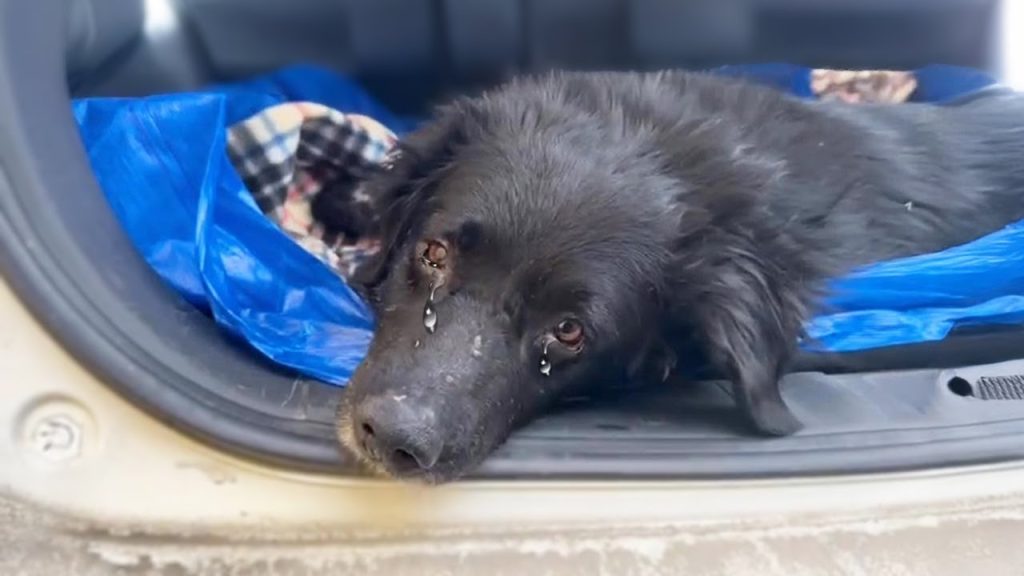
When rescuers finally reached him, they could see immediately that something was terribly wrong. Dymok could not use his back legs at all. Every small shift of his body seemed to require tremendous effort. He did not cry out loudly. Instead, he watched, as if unsure whether the hands reaching toward him would bring comfort or more pain. What they soon discovered would leave everyone shaken.
At the veterinary clinic, X-rays revealed a devastating truth. Dymok had been shot not once, but ten times. Ten separate injuries marked his small frame. One bullet had become lodged inside his spinal canal, causing irreversible damage that left him permanently paralyzed. His front legs, which he had relied on to pull himself forward during those desperate weeks, were fractured in multiple places. It was a level of cruelty almost impossible to comprehend.
The medical team worked carefully and compassionately, documenting each injury. The prognosis was guarded. Even with intervention, Dymok would never walk normally again. Some advised that the kindest option might be to let him go peacefully, to spare him from a lifetime of limitation and care. It was a practical assessment, rooted in realism. But sometimes, realism is not the only factor that matters.
His rescuer looked into his eyes and saw something others had nearly overlooked. Beneath the trauma, beneath the physical devastation, there was still life. There was still curiosity. There was still a flicker of joy when he was gently spoken to or stroked behind the ears. That spark changed everything. Instead of surrendering to the easier path, a decision was made to fight for him.
The road ahead was anything but simple. Dymok underwent a four-hour surgery to remove the bullets that could safely be extracted. The procedure was delicate and demanding, requiring precision and patience. After surgery, his body was wrapped in bandages, his movements limited, and his future uncertain. Recovery would not be measured in days, but in months of steady, painstaking effort.
Each day brought a routine of care. Gentle massages helped stimulate circulation in his paralyzed limbs. His front legs, once fractured and weak, required careful monitoring and rehabilitation. He needed assistance to eat, to reposition his body, to stay clean and comfortable. There were moments of fatigue, moments when progress seemed invisible. But there were also small victories: a brighter expression, a wag of the tail, a soft sigh of contentment while resting in the sun.
Over time, Dymok began to settle into his new reality. Though he would never walk on his own again, he discovered that life could still hold comfort and joy. He loved lying in warm patches of sunlight, soaking in the quiet peace of a safe home. He formed an unexpected friendship with a kitten, the two often resting side by side. The gentle companionship seemed to soothe him, reminding everyone that connection transcends physical limitations.
As his strength improved, plans were made to give him greater independence. A specially fitted wheelchair became part of his journey. Learning to use it required patience and encouragement. At first, the unfamiliar frame felt awkward. But with guidance and persistence, Dymok began to understand that the wheels were not a burden—they were freedom. Each small roll forward was a step toward reclaiming part of the mobility he had lost.
Through it all, he was given a name: Dymok. Naming him was more than a formality. It was a declaration that he was no longer forgotten, no longer a discarded life beside a trash can. He belonged to someone. He was seen. He was valued. His rescuer made a promise that day—to provide him with a forever home filled with love, patience, and dignity.
Today, Dymok’s life looks very different from those desperate weeks outdoors. He is surrounded by safety instead of uncertainty. His days are shaped by care instead of neglect. While his body carries permanent scars, his spirit reflects resilience. He may move differently than other dogs, but he moves forward nonetheless.
For many who follow his story, Dymok represents more than survival. He represents the quiet power of compassion. He reminds us that even when circumstances appear hopeless, there can still be a reason to choose mercy over convenience, hope over surrender. His journey asks an important question: How do we measure the worth of a life?
In Dymok’s case, the answer was not found in perfection or physical ability. It was found in the gentle lift of his eyes, in the trust that slowly returned, in the simple joy of basking in sunlight next to a small feline friend. It was found in the decision to fight for him when giving up would have been easier.
Dymok will always require special care. He will always rely on assistance and adaptive tools to navigate the world. But he will also always know what it means to be loved. And in that love, he has regained something even more important than mobility—he has regained dignity.
His story is painful, yes. But it is also profoundly hopeful. It shows that even in the aftermath of cruelty, kindness can rewrite the ending. And sometimes, that is enough to change everything.