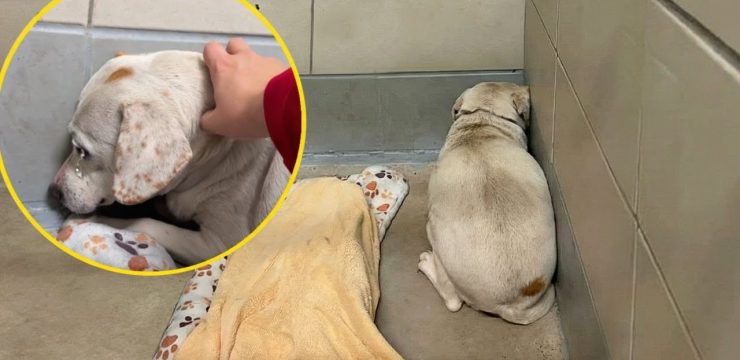
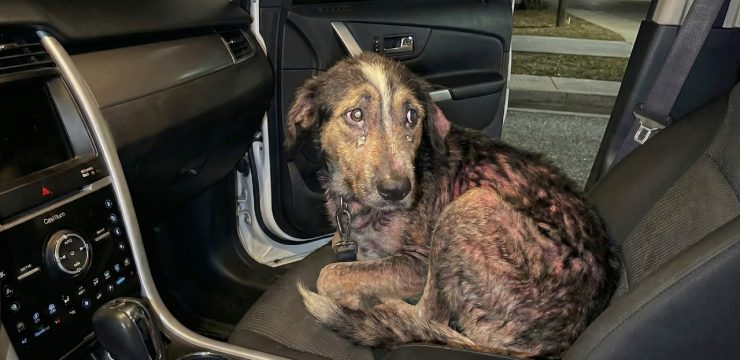
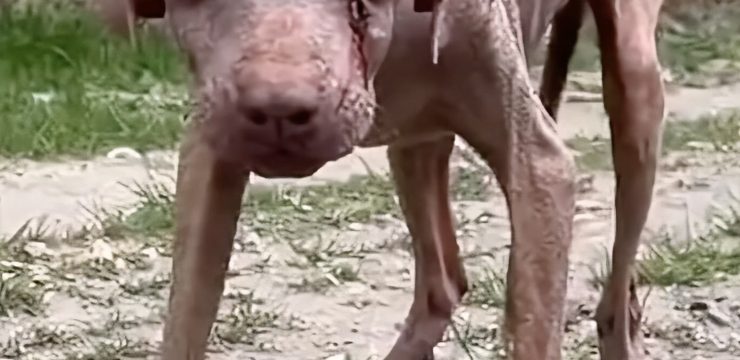
Sanya’s story begins in a place no living creature should ever have to endure. When he was first brought into the shelter, he was barely recognizable as a dog. Volunteers described him as a “walking skeleton,” his fragile frame covered in sores, his body carrying the heavy odor of long-term illness and neglect. Every rib showed through his thinning skin. His eyes, though open, seemed distant—like he had already given up on being seen.
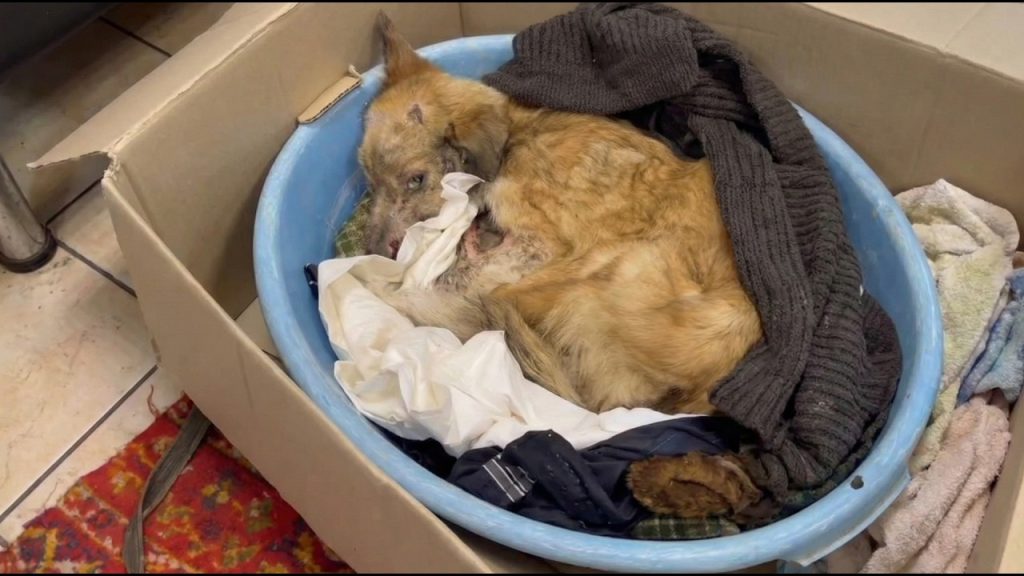
He was not simply underweight. He was exhausted in a way that goes beyond hunger. His muscles had wasted away. His body trembled from weakness. Even standing required effort. The team who received him understood immediately that this was not just a case of malnourishment; this was a life hanging by a thread.
At first, Sanya refused to eat. No matter how gently food was offered, he turned his head away. For a dog in such a condition, refusing nourishment can be fatal. His body was too depleted to sustain itself much longer. The rescue team had no choice but to step in with urgent medical support. He was given intravenous fluids to stabilize him and assisted feeding to ensure he received the nutrients his body desperately needed. Every small step mattered. Every swallow was a victory.
Those early days were uncertain. His system was fragile, and progress came slowly. But the volunteers did not give up. They monitored him closely, adjusting his care, keeping him warm, speaking softly to him even when he seemed too tired to respond. In shelters like this—privately run, often stretched beyond capacity—there is rarely a surplus of resources. Medical supplies are costly. Specialized food adds up. Yet they chose to invest in Sanya because every life entrusted to them matters.
Gradually, something began to shift.
It started with the smallest signs. A faint interest in the food placed before him. A hesitant lick. Then a few careful bites. As his appetite returned, so did a flicker of personality. The same dog who once lay motionless began to lift his head when someone entered the room. His eyes softened. His tail gave the slightest wag.
Over time, Sanya revealed who he truly was beneath the layers of suffering. He turned out to be sweet and a little shy, observing the world cautiously but with growing curiosity. And then came a delightful surprise—he had a mischievous streak. Once he discovered treats, he quickly learned how to “beg,” sitting up with an almost polite persistence that charmed everyone around him. It was as if he was rediscovering the joy of being a dog.
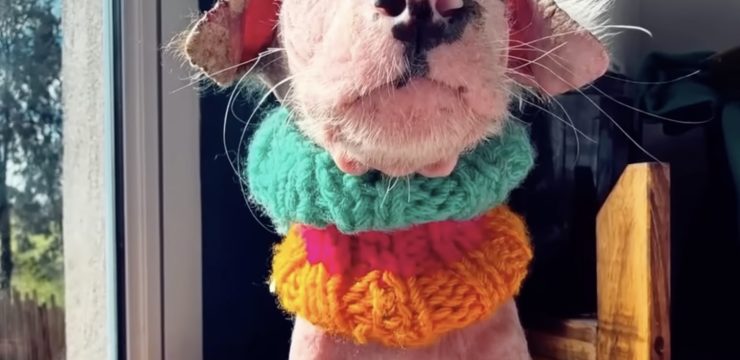
His digestive system, once unstable, began to regulate. The careful feeding plan paid off. His body absorbed nourishment instead of rejecting it. Strength returned to his legs. The trembling subsided. Slowly, almost miraculously, his coat began to grow back. Where there had once been irritated skin and sparse fur, a softer, healthier layer emerged. The transformation was not overnight, but it was undeniable.
Watching Sanya change from a shivering stray into a cuddly companion is a powerful reminder of what consistent care can do. Healing does not always come in dramatic leaps. Sometimes it arrives quietly, in daily routines, in patient hands, in meals prepared with intention.
Yet his story also sheds light on a larger reality. Private shelters like the one that saved Sanya operate under immense pressure. They take in animals who are injured, abused, abandoned, or severely neglected. Each case requires time, medical attention, and emotional energy. Veterinary treatments, medications, and specialized diets quickly strain limited budgets. The rising cost of medical supplies makes their mission even more challenging.
For every Sanya who survives and thrives, there are many others waiting for help. Community support is not a luxury for these organizations—it is a lifeline. Donations, shared awareness, and compassionate advocacy allow shelters to continue saying “yes” to the next dog in desperate need.
Sanya’s recovery is not just about physical restoration. It is about dignity restored. It is about a life that could have quietly faded away but instead was given another chance. For those who have loved dogs for decades, who understand the quiet loyalty in their eyes and the comfort of their presence, stories like this strike deep. They remind us that animals feel fear, hunger, and loneliness—but they also feel relief, safety, and joy.
Today, Sanya is no longer defined by the condition he arrived in. He is defined by resilience. By the way he leans gently into a caring hand. By the playful way he asks for a treat. By the soft fur that now invites affection instead of concern.
His journey affirms something many of us already know in our hearts: compassion has the power to transform. When we choose to see worth in a life that others overlooked, we participate in that transformation. We become part of the healing.
Sanya once stood at the edge of survival, too weak to eat, too tired to hope. Now he stands as living proof that even the most fragile beginnings can lead to beautiful second chapters. And for every person who played a role in his recovery—from the medical team to the volunteers who sat beside him—his wagging tail is the quiet thank-you that makes all the effort worthwhile.