It was a quiet Tuesday afternoon at the Millbrook Police Department, the kind of quiet that small-town stations know well. The fluorescent lights hummed overhead. A phone rang somewhere down the corridor, then stopped. Officer Diane Collins was halfway through a stack of parking reports when the front door opened with its familiar tired squeak.
She looked up, expecting a neighbor with a complaint about a barking dog, or maybe old Mr. Hadley again, asking about his missing mailbox.
Instead, she saw a little boy.
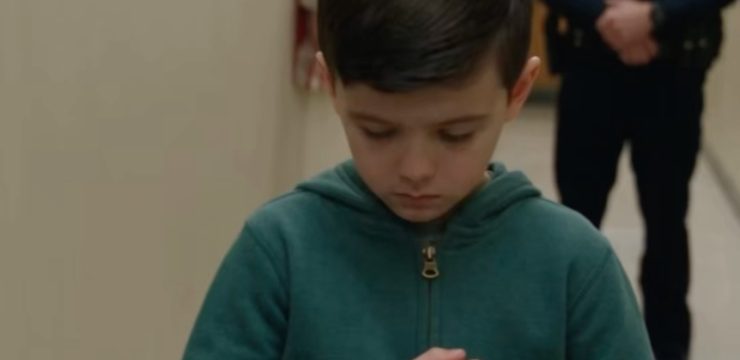
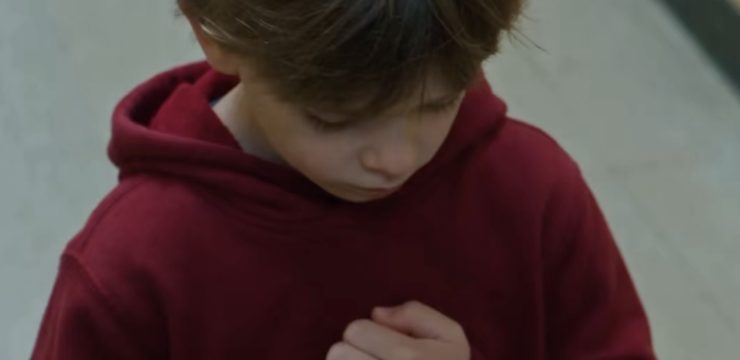
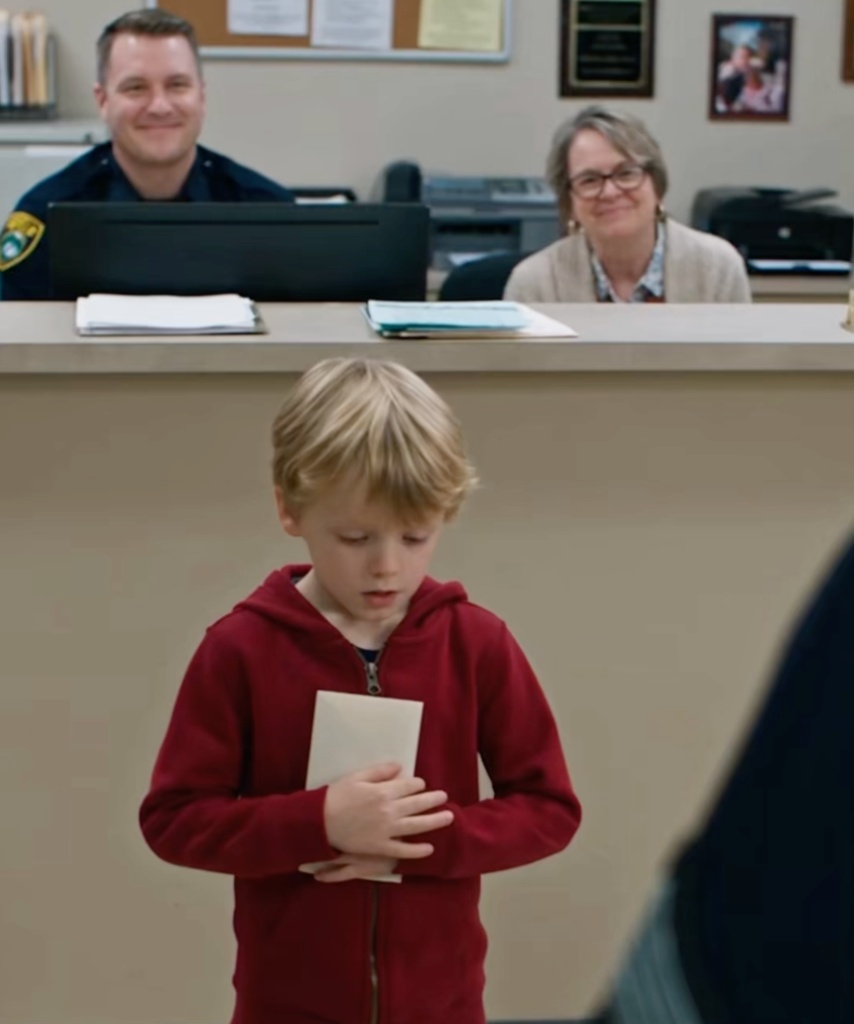
He couldn’t have been more than seven. He had fluffy blonde hair that stuck up in the back, big green eyes, and a red zip-up hoodie that looked a size too big. His sneakers were worn thin at the toes. He walked up to the front counter slowly, the way children walk into a doctor’s office, and he was holding a folded sheet of paper tightly against his chest with both hands, as if the wind might try to take it.
Through the glass door behind him, Diane could see an older woman sitting in a parked car, watching.
Officer Mike Reyes glanced up from his desk and smiled. Margaret, the front-office clerk who had worked at the station for twenty-two years, took off her glasses and leaned forward.
“Well, hello there, sweetheart,” Margaret said. “Are you lost?”
The boy shook his head. His eyes went to the silver name tag on Diane’s uniform. COLLINS. His lips moved silently as he read it, and something in his small face changed.
He looked up at her.
“Did you help a lady have a baby on the highway?” he asked softly.
Diane blinked. Then she laughed, a bright, surprised laugh that came from somewhere deep in her chest. She came around the counter and bent down to his level.
“Oh my,” she said warmly. “That was a long time ago, honey.”
It had been. Seven years ago this December.
She still remembered every second of that night.
The ice storm had rolled in faster than anyone predicted. Route 9 had turned into a sheet of glass, and Diane had been on patrol for eleven straight hours when she spotted hazard lights blinking on the shoulder near mile marker 42. An old blue sedan had slid halfway into the ditch.
Inside was a young woman, maybe twenty-five, gripping the steering wheel with both hands and breathing in short, frightened bursts.
“I’m sorry,” the woman kept saying. “I’m so sorry. I was trying to get to the hospital. He’s early. He’s three weeks early.”
Her name was Laura. She was alone. The baby’s father wasn’t in the picture, she explained between breaths, and her mother lived two hours away. Dispatch told Diane the ambulance was at least forty minutes out because of the ice.
The baby was not going to wait forty minutes.
Diane had been on the force for nearly twenty years by then. She had pulled a man out of a flipped pickup truck, directed traffic through a flood, and sat with more frightened people on more roadsides than she could count. But she had never done anything like this.
She and her late husband, Tom, had never been blessed with children of their own. For years it had been the quiet ache of her life, the thing she didn’t talk about at church potlucks or Christmas dinners. And now here she was, kneeling in the back seat of a stranger’s car in an ice storm, about to welcome someone else’s child into the world.
“Look at me, Laura,” she said, taking the young woman’s hand. “You are not alone. I’m right here, and I’m not going anywhere.”
With the dispatcher’s calm voice guiding her over the radio, Diane did exactly what she was told. At 11:52 p.m., in the orange glow of blinking hazard lights, a baby boy arrived, small and furious and crying at the top of his lungs.
Diane wrapped him in her own uniform jacket and placed him in his mother’s arms. Laura laughed and cried at the same time.
“You caught him,” she whispered. “You actually caught him.”
By then the storm had broken, and through the fogged window Diane could see stars coming out over the frozen fields. She would remember that sky for the rest of her life.
When the ambulance finally arrived, Laura squeezed her hand as the paramedics lifted her onto the stretcher.
“I’ll never forget you,” she said. “I promise.”
Diane visited the hospital once, bringing a small brown teddy bear from the gift shop. After that, life did what life does. Laura moved away. Diane went back to parking reports and traffic stops. But every December, when the first ice storm came through, she found herself wondering about that little boy. Was he healthy? Was he happy? Did he have someone to tuck him in at night?
She never expected to find out.
Now, in the bright light of the station, the little boy lowered his eyes. His bottom lip began to tremble.
“That… that baby was me,” he said. His voice was barely above a whisper. “Mommy wanted you to have this.”
He held out the folded paper with both hands.
Diane’s heart skipped. Slowly, carefully, she took it from him and unfolded it.
It was a drawing, done in colored pencil with patient, loving strokes. A police officer in a dark navy uniform knelt on a snowy roadside next to a blue car with little yellow lights blinking on its back. In her arms she held a tiny baby wrapped in a jacket. Above them, the sky was full of stars. The officer had auburn hair pulled back in a bun, and someone had taken the time to draw tiny freckles across her cheeks.
At the bottom, in neat handwriting, it said:
Officer Collins, the night you gave me my whole world. Thank you for catching him. — Laura
And beneath that, in handwriting that was newer and much shakier, as if written by a very tired hand:
Please tell her he’s a good boy. I made sure.
Diane’s smile disappeared.
She looked at the boy. Then at the drawing. Then back at the boy.
“Sweetheart,” she said carefully, “where’s your mommy?”
He stared at his sneakers.
“She got really sick,” he said. “She went to heaven three weeks ago.”
The station went completely still. Mike stood up slowly from his desk. Margaret pressed a hand against her heart.
“She drew that in the hospital,” the boy went on, his voice small and brave. “She said I had to give it to you myself. She said you were the very first person who ever held me.”
Diane raised a trembling hand to her mouth. Her eyes filled, and then the tears came, faster than she could stop them, rolling down her freckled cheeks. Her shoulders shook. For twenty-seven years she had stayed steady for everyone else, through every emergency and every hard phone call. But she could not stay steady for this.
The front door opened again. The older woman from the car stepped inside, her eyes already red.
“I’m Ruth,” she said quietly. “Laura’s mother. I’m sorry to just show up like this.”
She explained everything. Laura had become an art teacher. She had raised her son on her own and raised him well. Over the years she had thought about finding Officer Collins many times, but she always worried the officer wouldn’t remember her, that it had been just one more night on the job.
“When she got sick,” Ruth said, “she spent her last good weeks drawing. This was the very last thing she finished. She told me, ‘Mom, she needs to know he turned out okay. She needs to know what she did mattered.'”
Ruth rested a hand on the boy’s shoulder.
“There’s one more thing Laura wanted you to know,” she said. “His name is Caleb. Caleb Collins Bennett. She gave him your name the morning after he was born.”
Diane couldn’t speak. She simply knelt down on the station floor and opened her arms, and Caleb walked right into them. She held him the way she had held him once before, seven years ago, on the side of a frozen highway under a sky full of stars.
“I never forgot you,” she whispered into his hair. “Not one single day.”
Caleb pulled back and looked at her with those big green eyes.
“Mommy said you’d say that.”
Today, that drawing hangs in a simple wooden frame on the wall of the Millbrook Police Department, right between the Little League team photo and the Fourth of July parade picture. Visitors sometimes stop and ask about it. Margaret always tells them the whole story, and she has never once made it to the end without reaching for a tissue.
And every year on December 14th, a little boy in a red hoodie walks through the front door with his grandmother, carrying two cups of hot cocoa. One for him, and one for the officer who caught him.
Diane Collins never had children of her own. But now she has a birthday to remember, a school play to attend every spring, and a small hand that reaches for hers every time they cross the parking lot.
Sometimes the people we help for just one night carry us with them for a lifetime. We may never know it. But every once in a while, if we’re lucky, a small hand knocks on our door to tell us.