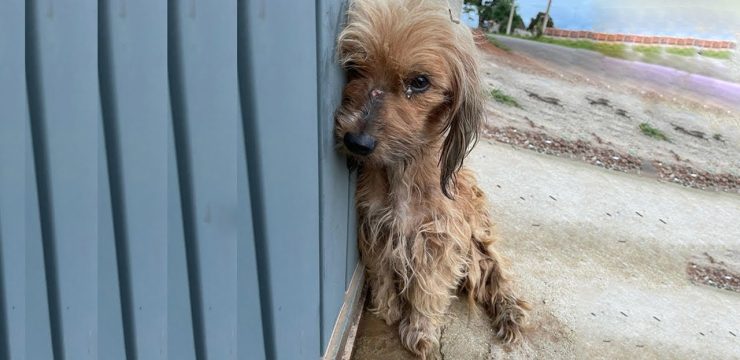
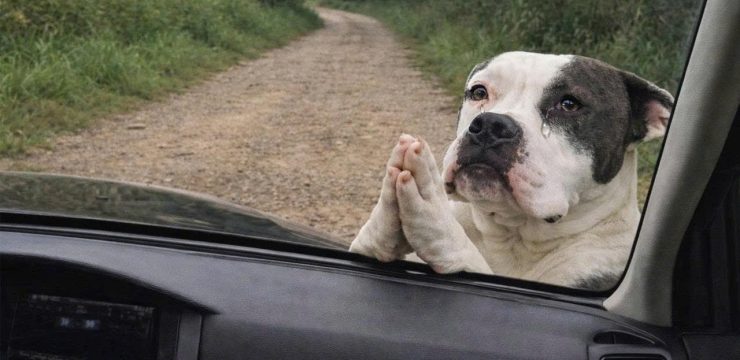
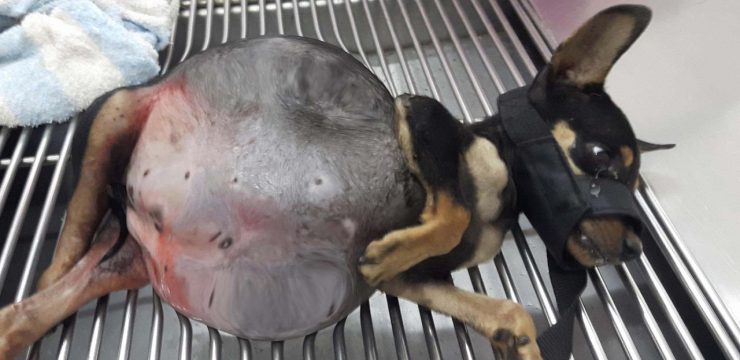
An elderly dog, later named Khalifa, spent seven years believing he had a forever home. He had grown old at the same doorstep, watched the same sunsets, and waited each evening for familiar footsteps to return. Then one day, the door closed—and never opened for him again.
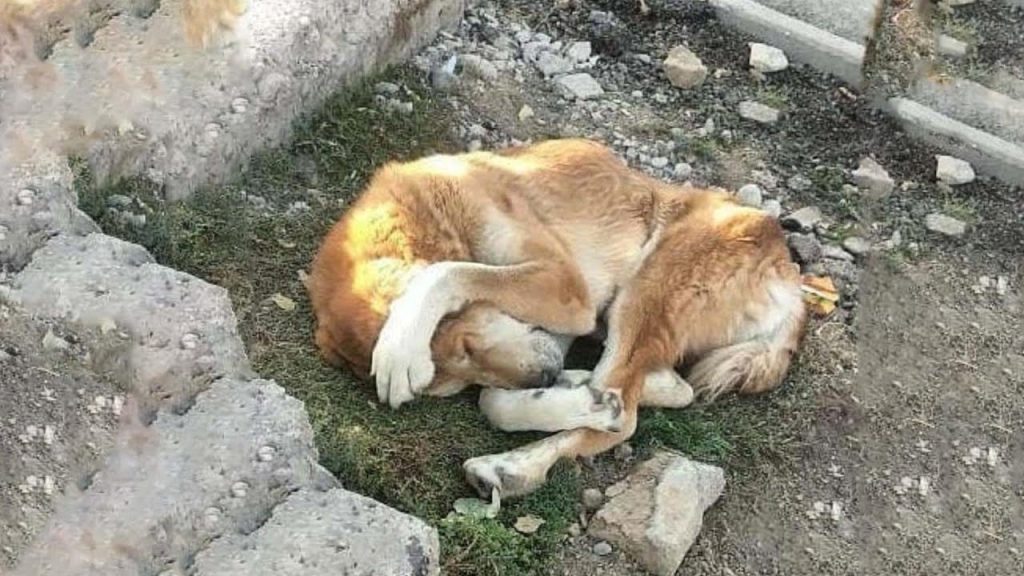
Left behind by the only family he had ever known, Khalifa did not understand what had happened. He stayed right there on the porch, as if loyalty alone could undo the silence. For an entire month, he waited faithfully outside the house that used to be his world. Neighbors would hear him crying softly at night, a low, aching sound of confusion and hope. He refused to wander far. In his heart, he was still home.
Days turned into weeks. His once-healthy frame began to shrink. Without steady food or water, his body weakened. Yet he would not leave. Every passing car made him lift his head. Every creak of a door stirred a flicker of expectation. The bond he believed in had not faded, even if the people were gone.
It was a concerned neighbor who finally made the call for help. When rescuers arrived, they found a dog who was barely recognizable from the companion he must once have been. Khalifa was emaciated, his ribs sharply visible beneath thinning fur. His eyes carried a deep sadness, and he trembled with fear. Even then, he hesitated to step away from the porch. It was the last place he had felt secure. Leaving it meant accepting a truth he was not ready to face.
Gently, patiently, the rescue team coaxed him into their vehicle. He resisted at first, pulling back toward the door he had guarded so faithfully. It was not stubbornness; it was heartbreak. Eventually, exhaustion won. Khalifa allowed himself to be lifted, still glancing behind as if someone might finally call his name.
At the veterinary clinic, the seriousness of his condition became clear. His body temperature had soared to 105 degrees Fahrenheit, a dangerous fever that signaled severe distress. He was profoundly dehydrated, and he reacted painfully when his abdomen was examined. Further evaluation revealed a serious internal blockage that required immediate medical attention. His life was hanging in the balance.
Veterinarians worked quickly to stabilize him. Intravenous fluids were administered to combat dehydration. Medications were carefully given to reduce his fever and address inflammation. The blockage required intensive treatment and close monitoring. Every hour mattered. Khalifa was fragile, not only because of his age, but because his body had endured far too much neglect.
Yet while his physical condition was critical, something even more difficult to measure weighed heavily on him. In the quiet of his kennel, he did not bark. He did not whine. He simply stared at the wall for long stretches of time, motionless and withdrawn. Volunteers described it as a kind of silent grieving. The dog who had once waited so faithfully now seemed unsure how to hope at all.
Healing, however, is not always loud. It often begins in small, almost invisible shifts. With consistent care, gentle voices, and steady routines, Khalifa slowly began to respond. A soft blanket. A warm hand resting near him without pressure. A calm presence that asked nothing in return. These simple acts began to rebuild a sense of safety.
When he was strong enough, short daily walks were introduced. At first, he moved cautiously, each step uncertain. But the fresh air seemed to awaken something within him. He paused to sniff the grass. He lifted his head at the sound of birds. Curiosity, long buried beneath fear, began to resurface.
One day, as a volunteer knelt beside him, Khalifa did something no one had seen since his rescue. The corners of his mouth lifted slightly, and his eyes softened. It was subtle, but unmistakable—a small, genuine smile. For those who had watched him sit in silence for days, it felt like a breakthrough. It was the moment hope returned.
Proper nutrition played a vital role in his recovery. With balanced meals and carefully selected joint supplements, the chronic limp that had troubled him for years began to ease. His muscles regained strength. His coat grew fuller. The gaunt outline that once defined him softened into a healthier frame. Age had not defeated him; he simply needed support.
More importantly, Khalifa learned to trust again. He discovered that not every hand would leave. Not every door would close forever. He found comfort in companionship and began leaning gently into the people who cared for him. The porch he once guarded faded into memory, replaced by new routines and new affection.
Today, Khalifa is a transformed dog. He moves with renewed energy, his eyes bright and attentive. While the past cannot be erased, it no longer defines him. He has stepped fully into his golden years, surrounded by warmth, stability, and love. The sorrow that once shadowed him has given way to quiet contentment.
His story is a reminder of two powerful truths. First, abandonment leaves wounds that go far beyond the physical. Second, compassion has the power to restore what neglect nearly destroys. Khalifa’s journey from heartbreak to healing speaks not only to the resilience of animals, but to the extraordinary difference that patience and kindness can make.
In the end, he did not lose everything. He lost a house, but he found a home. And in that home, he is finally receiving the devotion he always gave so freely.