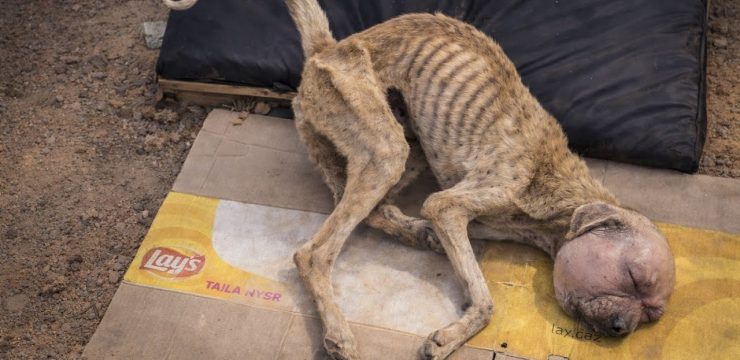
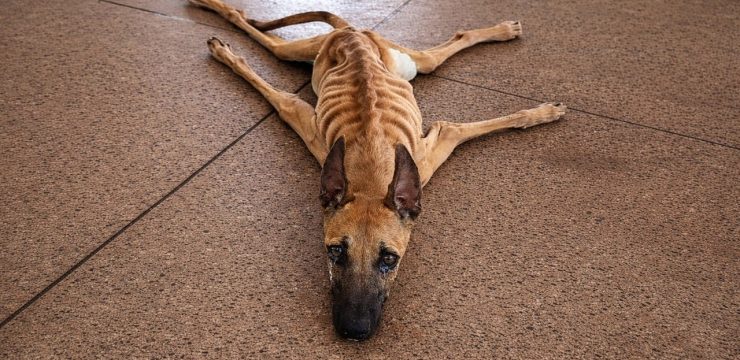
Wolf’s story begins in a place no living creature should ever have to endure—alone, starving, and quietly fading away after being abandoned by the very person he trusted most. When rescuers first found him, he weighed only twenty pounds, barely half of what a healthy dog his size should have weighed. His ribs pushed sharply against his thin skin, his hips jutted out painfully, and he was too weak to stand on his own. Every small movement looked like it cost him more energy than he had left to give.
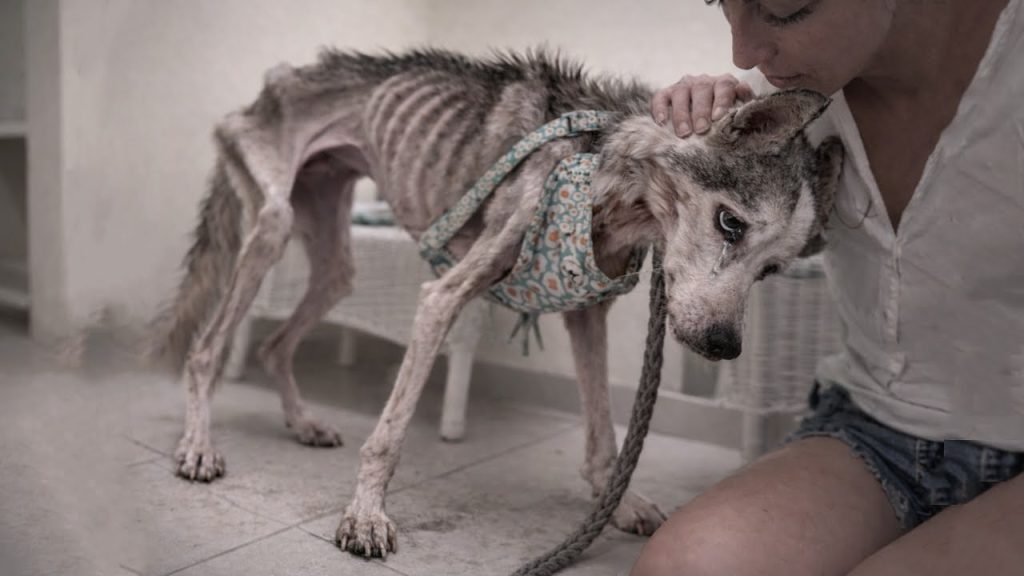
He had been surviving the only way he could—by scavenging spoiled food, eating whatever scraps he could find just to keep breathing one more day. But even that fragile survival came at a terrible cost. A dangerous infection had taken hold in his abdomen, silently threatening to end his life. His body was failing, but what struck his rescuers most was not just the physical devastation. It was the emptiness in his eyes.
Wolf wasn’t simply underweight. He was broken in spirit.
When they approached him, he flinched. When they offered food, he turned away. He was too frightened to eat in the presence of humans. That kind of fear doesn’t appear overnight. It grows from betrayal, from confusion, from repeated moments of abandonment that teach an animal the world is not safe. For Wolf, trust had become something dangerous.
Yet even in that fragile state, there was a quiet will inside him. His rescuers saw it in the way he lifted his head just slightly when they spoke gently to him. They saw it in the faint flicker of awareness when they offered soft words instead of sudden movements. Healing, they knew, would require more than medicine. It would require patience measured in hours, days, and weeks. It would require love without expectation.
The first victories were small. A few hesitant bites of carefully prepared food. A longer glance without fear. A moment when he allowed a gentle touch without pulling away. His body began to respond to proper nourishment and veterinary care. Slowly, his strength returned. The sharp angles of his bones softened. His coat began to regain a hint of life. He could stand for short periods. Then he could take a few shaky steps.
But emotional healing does not follow a straight line. Just as hope began to take root, everything nearly unraveled.
One day, without warning, Wolf collapsed.
The room that had been filled with cautious optimism turned into a scene of urgent alarm. He was rushed for emergency surgery. The infection inside him had worsened, and his condition was critical. The prognosis was devastating. He had only a ten percent chance of surviving the operation.
For anyone who has ever loved an animal, those words are almost impossible to hear. Ten percent is not reassurance. It is a whisper of hope in a storm of fear.
Yet Wolf had already proven he was a fighter.
The surgery was long and uncertain. His body, already weakened from months of neglect, had to endure more than most would believe possible. But against the odds, he held on. Breath by breath, heartbeat by heartbeat, he refused to give up. When the procedure was over and the first signs of stability appeared, it felt nothing short of miraculous.
Recovery after surgery was slow and delicate. There were no dramatic leaps forward, only careful steps. Rest. Monitoring. Gentle encouragement. But something had changed in him. The fear that once froze him began to loosen its grip. He started eating more confidently. He began to lift his head higher when someone entered the room. His tail, once motionless, gave the faintest wag.
As weeks turned into months, the transformation became undeniable.
The skeletal dog who could not stand was replaced by one who could walk with growing confidence. The frightened soul who would not eat in front of people began to seek out human presence. His eyes, once clouded by pain and mistrust, grew bright with curiosity. He learned what it felt like to be safe.
Today, Wolf is a different dog entirely. He carries healthy weight on his frame. His coat shines. He moves with energy instead of exhaustion. Most importantly, he is surrounded by affection—the very thing he was once denied. Gentle hands no longer represent danger. They represent comfort. Voices no longer trigger fear. They signal belonging.
His journey is not just a rescue story. It is a testament to resilience.
For those of us who have lived long enough to understand life’s hardships, Wolf’s path feels deeply familiar. We know what it means to endure loss, to feel betrayed, to wonder whether healing is possible after being hurt. And we also know the power of steady kindness. The kind that does not demand instant change. The kind that shows up again and again, even when progress is barely visible.
Wolf survived because someone chose compassion over indifference. Because someone saw value in a life that others had cast aside. Because patience outlasted despair.
His story reminds us that recovery is rarely dramatic. It is built from countless small acts of care. A warm bed. A nourishing meal. A gentle touch. A decision to try again tomorrow.
In a world that often moves too fast, Wolf’s journey calls us back to something simple and enduring: love has the power to restore what neglect tried to erase. And the spirit of an animal, when given even the smallest chance, can rise stronger than anyone expects.
That is not just inspiring. It is a lesson in humanity.